The Margarita Masterclass: Mixology Tips and Techniques
A more consistent margarita starts with understanding what goes into the glass and what happens in the shaker. Measure your ingredients, use ice deliberately, and change one thing at a time when adjusting the drink. Those habits help whether you prefer a sharp, lime-forward margarita or something softer and sweeter.
This masterclass brings the whole process together: choosing ingredients, shaking, muddling, straining, and finishing the glass. Start with a recipe you enjoy. Then use these techniques to make your next version more intentional.
Know what each ingredient contributes
Tequila: read the label before judging the price
A tequila labeled “100% agave” uses only blue Weber agave sugars in its fermentation formulation. That designation does not, by itself, establish that the finished tequila is additive-free. Mexico’s tequila standard addresses sugar sourcing and permitted additions separately; the details also depend on the tequila’s class. Avoid treating a category label as a complete ingredient or production disclosure. See NOM-006-SCFI-2012, sections 4.36, 5.1.1 and 6.1.1.1.
The aging terms are useful, too. Blanco can have less than two months of oak maturation; reposado requires at least two months, and añejo at least one year. These definitions come from sections 4.36.1, 4.36.3 and 4.36.4 of the same standard.
For your margarita, choose a bottle that fits your budget and the character you want. Price alone cannot tell you which combination you will prefer. Record the exact tequila when a drink works well so you can repeat it.
Orange liqueur: make the substitution knowingly
Triple sec is a style of orange liqueur, and Cointreau belongs within that discussion. The producer identifies Cointreau as an orange triple sec at 40% ABV. Grand Marnier Cordon Rouge combines cognac and orange liqueur; its US producer page also lists 40% ABV. ABV means alcohol by volume.
These are ingredient distinctions, not a ranking. Changing bottles may alter the drink’s orange character and its balance. Keep the first comparison simple: use the same recipe and change only the liqueur. Check your own bottle’s label, since the product and market matter.
Lime juice: measure the juice, not the fruit
Freshly squeezed lime is a useful starting point, and it appears in the International Bartenders Association’s margarita. Measure the juice in mL rather than relying on “one lime.” That makes your instructions easier to repeat.
If you use bottled juice, lime cordial, or a prepared mixer, identify the exact product. Check whether it already includes sugar or other ingredients. Treat the substitution as a change to the recipe rather than assuming every lime-flavored liquid is interchangeable.
Sweetener: keep concentration in view
Orange liqueur already contributes sweetness, so additional syrup is a choice for the recipe and your palate. If you use simple syrup, record its sugar-to-water ratio and whether that ratio is by mass or volume. For agave syrup, record the product and any dilution.
When a drink needs adjusting, make a small measured change and write it down. For example, a 2 mL syrup adjustment is a recording increment, not a universal correction. The result depends on the syrup and the drink you started with. WSET’s home-cocktail guidance likewise encourages adjusting sweet and sour balance to your own palate.
Set up before the ice goes in
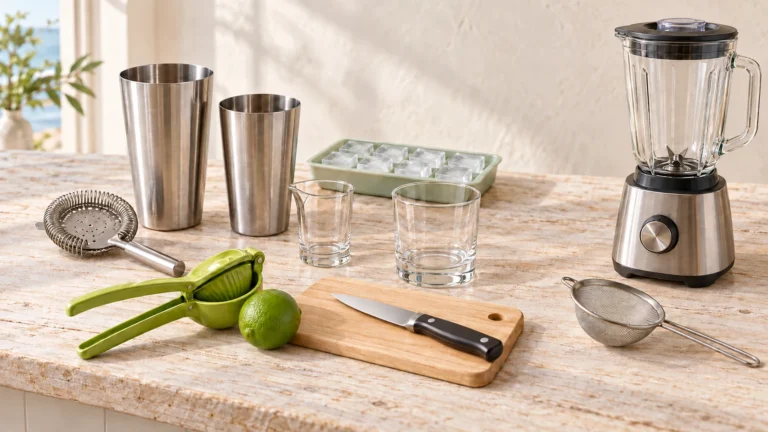
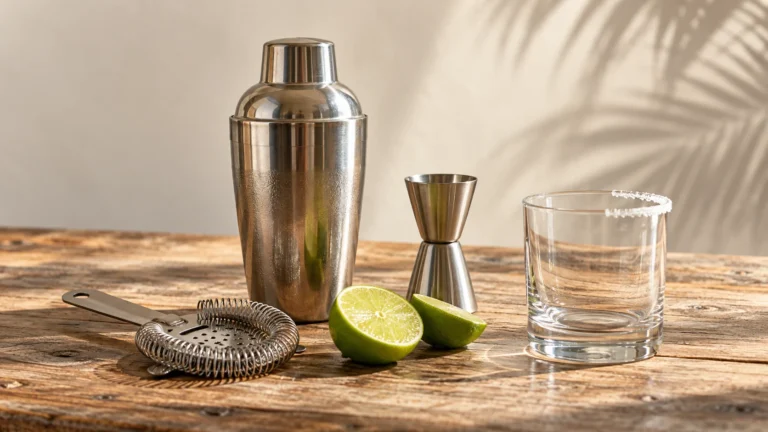
Have your chosen recipe, ingredients, serving glass, and garnish ready. You will need a cocktail shaker, an mL-marked measure, and a strainer that fits your shaker. A citrus press is helpful; a fine-mesh sieve is useful when you want to remove smaller fragments. Add a muddler only if your recipe calls for it.
Record every liquid amount, including optional syrup. Keep the products and preparation consistent before deciding that a recipe needs changing. Our guide to measuring margarita ingredients consistently covers the measuring step in more detail.
Prepare the rim before filling the glass, and keep clean ice ready for both mixing and serving. If you are making drinks for several people, work within the shaker’s capacity rather than crowding everything into one batch.
Shake a classic lime-juice margarita
Shaking mixes, chills, dilutes, and aerates a cocktail. Aeration means introducing small air bubbles. Stirring also mixes, chills, and dilutes, but introduces less air. Simon Difford’s technique explanation describes these differences.
For a classic margarita with lime juice, shaking is the usual starting method. The IBA instructions say, “Shake and strain into a chilled cocktail glass.” An expensive tequila does not create a special requirement to stir. Choose the method for the recipe and texture you want.
A repeatable shaking sequence
- Measure your recipe’s non-carbonated liquid ingredients into the shaker.
- Add fresh cubed ice, leaving room for the contents to move.
- Secure the shaker and hold both parts firmly. Shake away from other people.
- Shake briskly for about 10–15 seconds as a starting guide, then strain promptly. Shaker size, ice, and the amount of liquid affect the result.
- For a drink served without ice, use a chilled cocktail glass. For a drink on the rocks, strain over fresh serving ice.
This sequence follows the basic approach in Difford’s shaking guide. Avoid shaking carbonated ingredients in a closed shaker. If your variation includes soda, add it according to that recipe after shaking the other ingredients.
Treat dilution as part of preparation
Water from melting ice becomes part of the cocktail. Your method should account for it rather than treating every drop as a mistake. Use a consistent ice supply and workflow when comparing versions. Do not promise an exact dilution percentage from a stopwatch alone.
After serving, an on-the-rocks margarita continues changing as its ice melts. Note whether a drink tastes unbalanced immediately or only after it has been sitting. Those are different problems to investigate.
Muddle and strain with a purpose
Muddling: release flavor without making a mess
Muddling presses ingredients to release their flavor. Use the base of a sturdy metal shaker rather than a delicate serving glass. Difford’s muddling guidance specifically warns about glass breaking under pressure.
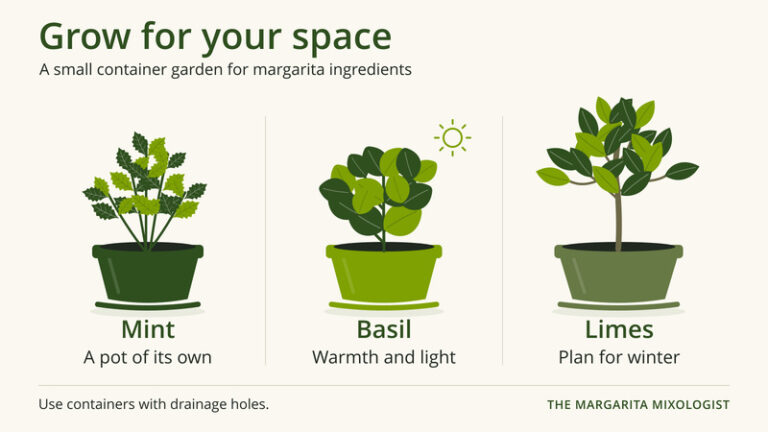
For a recipe with soft herbs, begin with gentle pressure rather than grinding them into a paste. Softer fruit and firmer ingredients need different handling. Follow the recipe’s amount and preparation, then keep your technique consistent. A chili garnish and muddled chili are different choices; do not silently substitute one for the other.
Double straining: use two strainers in sequence
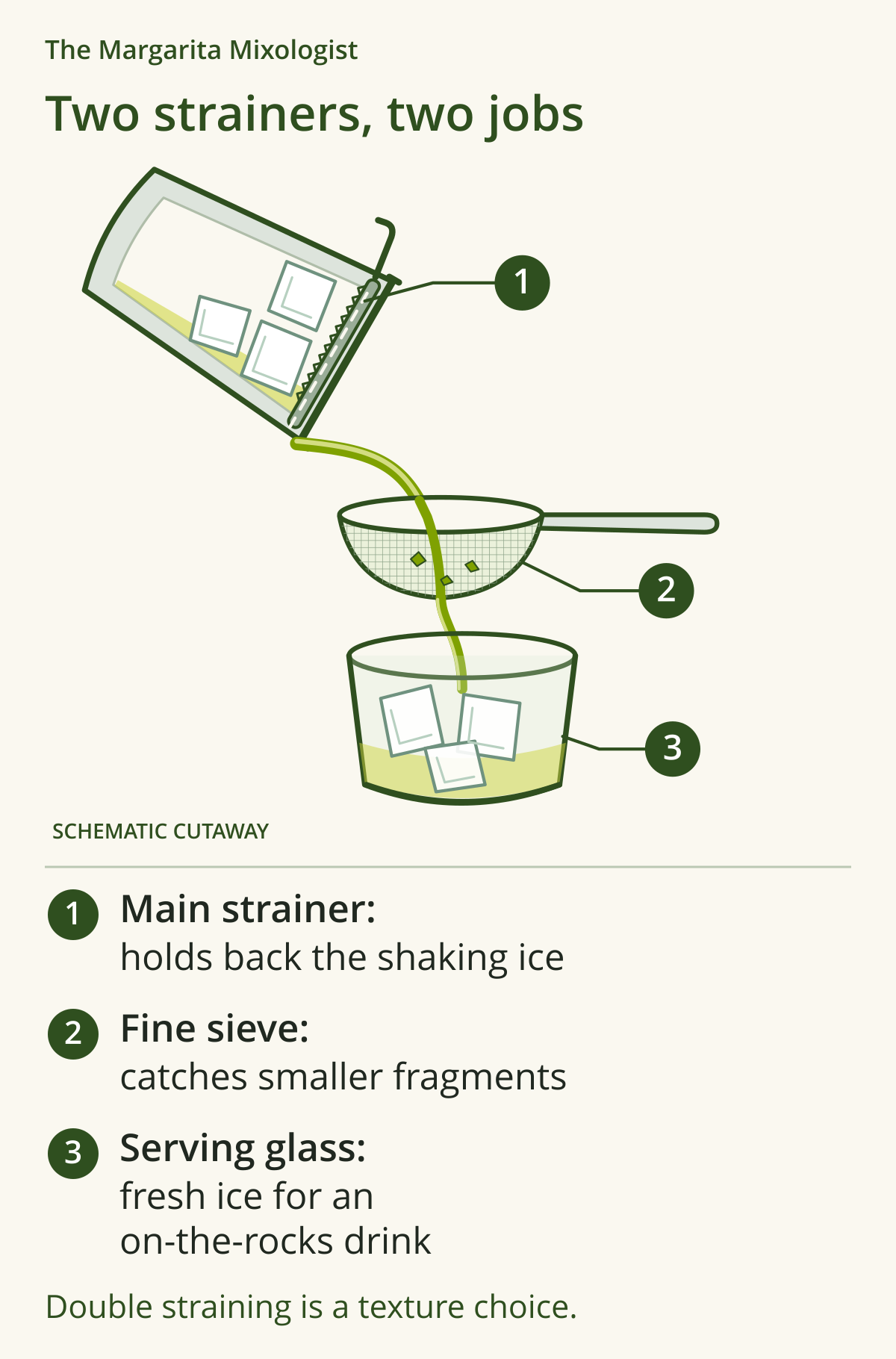
Double straining combines the shaker’s main strainer with a fine-mesh sieve. Keep the main strainer at the shaker opening to hold back the mixing ice. Hold the sieve above the serving glass and pour through both. The finer mesh catches smaller ice and ingredient fragments.
It is useful when bits of herbs, seeds, or pulp are unwelcome. It is optional when those textures are part of the intended drink. Difford’s discussion of fine straining includes different bartender preferences; there is no need to promise that every double-strained margarita is better.
Finish the glass for the way you want to drink
Choose glassware around the serving style. A rocks glass accommodates serving ice; a stemmed cocktail glass suits a drink served without ice. Leave enough room to carry and sip comfortably. The glass’s advertised capacity is not an instruction to fill it with alcohol.
A half rim offers a simple choice between salted and unsalted sips. It is also the optional garnish in the IBA margarita specification. To apply one, moisten only the outside half of the rim with lime. Touch that section to a shallow plate of salt, then gently tap off the excess before adding the drink.
Use sugar or a food-grade spice mixture if it suits your recipe, and label spicy rims for guests. A lime wedge or a fresh culinary-herb sprig can be enough garnish. Keep the drinking edge accessible. More decoration is not automatically more useful.
Build a signature variation one change at a time
Fruit, herbs, spice, and infused tequila all offer room to explore. First decide what you want to change: the aroma, sweetness, texture, or heat. Then choose one route.
- Fruit: record the fruit, preparation, and amount. Juice, purée, and muddled pieces are different inputs. A thicker purée may call for a different straining approach.
- Herbs: decide whether the herb belongs in the mixture or only as a garnish. Keep that distinction in your notes.
- Spice: start with a recipe that specifies the ingredient and quantity. Record whether the spice is incorporated or restricted to the rim.
- Infusion: use an ingredient-specific method with handling and storage instructions. Do not assume a single “steep for two days” rule works for every fruit, herb, and chili.
Keep a short record: base recipe, exact products, amounts in mL where appropriate, ice, technique, one change, and your own observations. This is a way to learn what you prefer, not a claim that someone else must enjoy the same version.
Troubleshoot before changing everything
- Too tart for you? Recheck the lime and sweetener measurements. In the next version, change one of those amounts and record it.
- Too sweet? Check for sweetness in the liqueur, syrup, and any mixer. Avoid reducing several ingredients at once.
- Thin or watery? Note when the problem appeared. Check for meltwater carried into the shaker, inconsistent pours, and time spent on serving ice.
- Too many fragments? Consider double straining. If you prefer pulp or fine ice flecks, keep them intentionally.
- Hard to repeat? Check the basics before buying a new bottle: measured amounts, exact products, ice, and preparation.
For your next margarita, choose one habit to practice: precise measurement, a consistent shake, purposeful straining, or a half rim. Write down what you changed and whether you liked the result. That is a useful masterclass, even without a crowded bar cart.