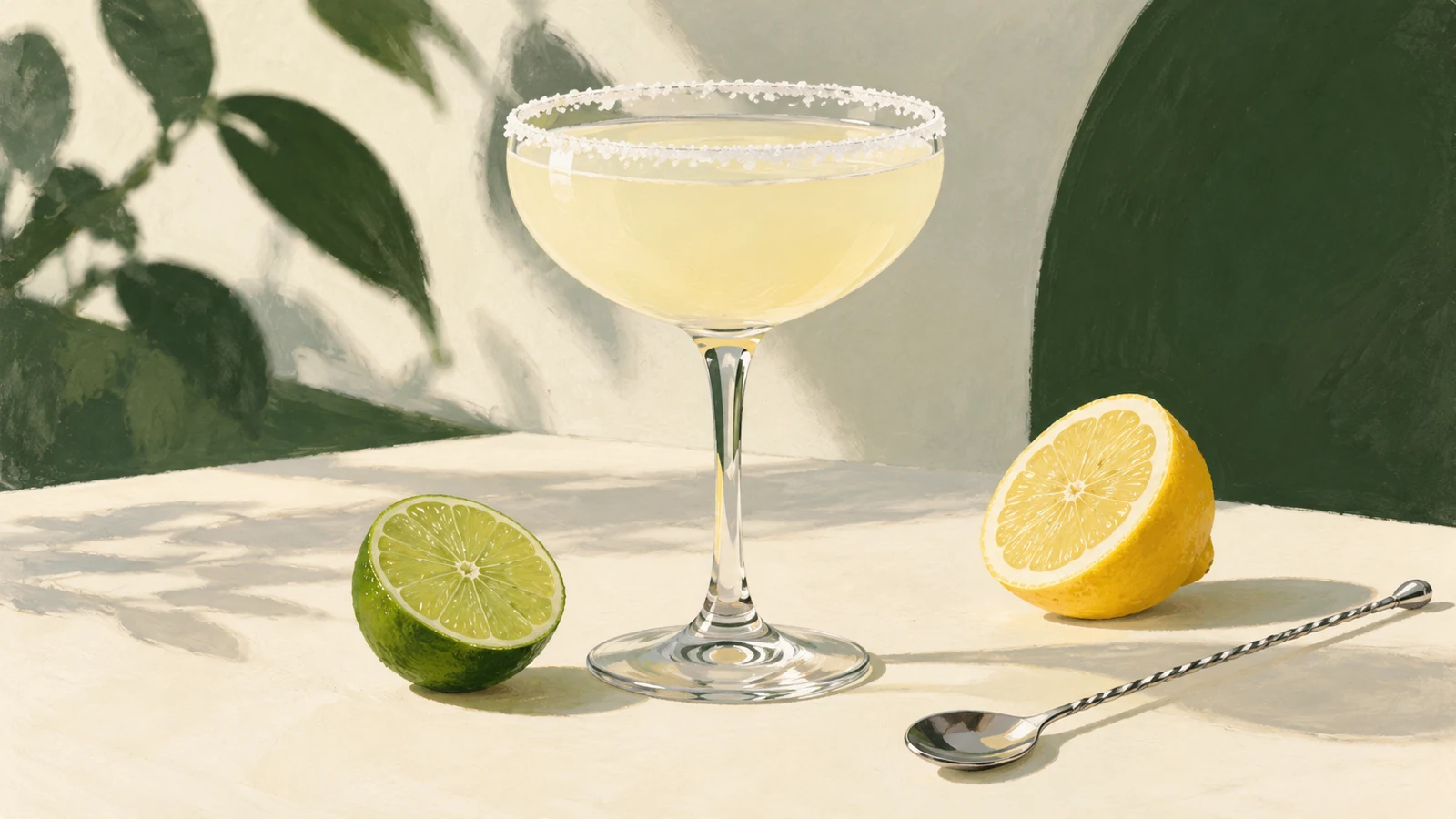
Esquire’s 1953 margarita recipe is brief enough to leave some important choices to the person making it. It calls for tequila, a dash of triple sec, and juice from half a lime or lemon. The interesting detail is how little it fixes about the last two quantities. Turning that description into a precise modern ratio requires decisions the printed recipe never makes.
This is a close reading of a historical recipe, with corrections to our earlier version. We have not prepared or taste-tested this reconstruction.
What we could verify
We examined a photographic reproduction of the original clipping in Academia Patrón’s Mixología de México, printed page 12, which is page 14 in the PDF. Its caption identifies “Painting the Town,” Esquire, December 1953, page 76. The clipping labels the margarita “Drink of the Month.” View the reproduced clipping.
That is a reproduction of the entry, rather than our independent inspection of the complete original magazine page. Esquire’s own archive lists the December 1953 issue; access to its full-page viewer requires a subscription. The publisher also recalls the 1953 feature in its 2019 margarita article.
The evidence supports discussing this published example. A dated recipe alone cannot establish who invented the drink, when someone first mixed it, or whether it was the first recipe ever printed. Those are separate historical questions, so this page makes no first-ever or inventor claim.
Read the quantities as written
- Tequila: one ounce. The clipping does not name a brand or expression.
- Triple sec: a dash, with no volume assigned.
- Citrus: the juice obtained from half a lime or half a lemon.
Its method uses crushed ice and stirring, followed by a stemmed glass with a citrus-moistened, salted rim. It does not give a stirring time, a measured dilution, or a garnish. The recipe card below paraphrases that short method and keeps the unresolved measurements visible.
Why there is no exact historical ratio here
A ratio compares amounts measured on the same basis. An ounce, an unmeasured dash, and half a fruit do not supply three known liquid volumes. To calculate a reproducible ratio, you would first have to measure the actual dash and extracted juice.
For example, choosing a quarter-ounce pour of triple sec would create a measured interpretation. Calling that choice the historical definition of a dash would go beyond the evidence. The same applies to treating half a fruit as half an ounce of juice.
Our earlier page mixed incompatible claims: a 2:1:1 ratio, a 48:1:12 ratio, and a quarter-ounce interpretation of the dash. It also presented a larger version as a direct scaling of the original. Those claims have been removed. There is no verified fixed-volume recipe behind them.
For the same reason, we are leaving the Margarita Flavor Key unassigned and omitting nutrition and strength estimates. A precise-looking code or calorie total would hide the missing inputs.
If you try a measured interpretation
Keep a small record of your choices. Write down the tequila and orange liqueur you use, your dash volume, the type of citrus, and how much juice you actually extract. Also record the ice, mixing time, and how you transfer the drink to its serving glass. These details describe your version; they do not retroactively supply missing instructions to the historical source.
If you want to compare lime with lemon, hold the other choices steady and record each version separately. Describe your own observations rather than assuming the historical wording guarantees a particular sweetness, strength, or flavor.
For help keeping those measurements consistent, see our guide to measuring margarita ingredients.
Correction and source note
This update replaces unsupported first-publication, brand-popularity, flavor, ratio, scaling, and nutrition claims. The recipe retains its historical quantities, including their uncertainty. The clipping is linked for reference; it is not reproduced here as artwork. The accompanying graphic is an original explanatory illustration.
Esquire’s Margarita (1953): historical recipe
Equipment
- 1 Jigger
Ingredients
- 1 US fl oz Tequila No brand or expression specified. Modern conversion treats the ounce as a US fluid ounce.
- 1 dash Triple Sec The source gives no volume for the dash.
- ½ lime or lemon, juiced Use the juice from this amount of fruit, not a fixed volume of juice.
- crushed ice For mixing; amount and melt dilution unspecified.
- salt and citrus rind For the glass rim; not a measured incorporated ingredient.

Instructions
- Moisten the rim of a stemmed serving glass with citrus rind, then coat the rim with salt.
- Extract the juice from the listed amount of lime or lemon. The amount is a fraction of a fruit, not an ounce measure.
- Measure the listed tequila and add the listed dash of triple sec. No fixed dash volume is specified by the historical source.
- Combine the tequila, triple sec, and extracted citrus juice over crushed ice.
- Stir, then pour into the prepared glass. The clipping does not specify a stirring duration or whether to retain or strain away the mixing ice.
Notes
My Notes
Available to subscribers!